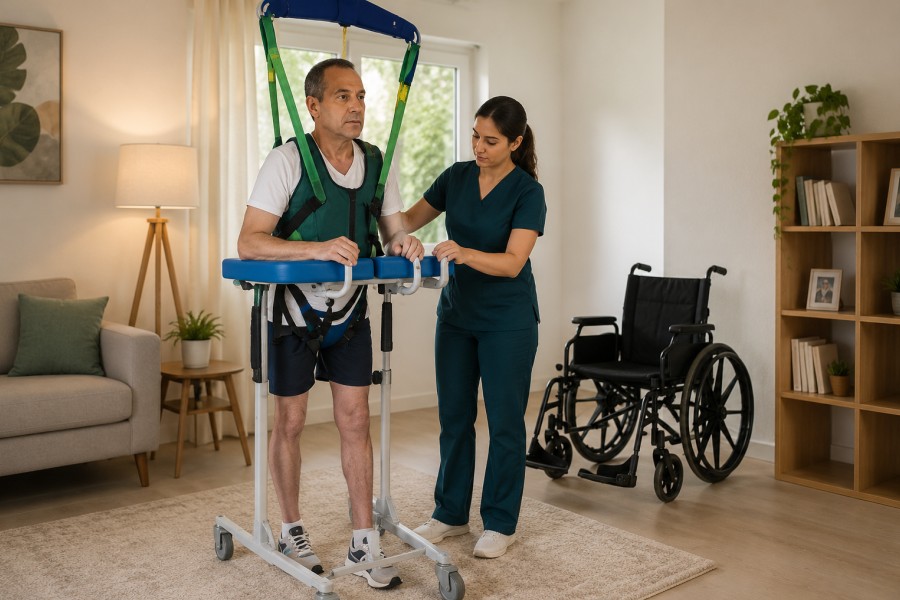
Home Physio Derbyshire provides private spinal cord injury rehabilitation in Derby and across Derbyshire, delivered directly to your home. Whatever the level and extent of injury, our physiotherapists build a programme focused on maximising movement, function, and independence, and on protecting long-term health, delivered where daily life happens, alongside the wider care team, with no GP referral needed.
A spinal cord injury affects movement and sensation below the level of the injury, because the spinal cord carries the signals between the brain and the body. The level of the injury, how high or low on the spine, and whether it is complete or incomplete, shape which functions are affected and what rehabilitation aims to achieve, which is why every programme is built around the individual. Physiotherapy plays a central role in maximising the movement and function that are available, building strength and independence, and preventing the secondary complications that a spinal cord injury can bring.
Physiotherapy after a spinal cord injury focuses on:
Because the pattern of a spinal cord injury is specific to each person, a thorough individual assessment is essential, and the whole programme is shaped around it and the person's goals.
Rehabilitation after a spinal cord injury is a long-term process, and consistent physiotherapy matters both for building function and for protecting long-term health. Preventing secondary complications is a particular priority: without regular movement and stretching, problems such as joint contractures, muscle tightness, and deconditioning can develop and reduce function further, and ongoing physiotherapy helps prevent them. For incomplete injuries, where some function is preserved or returning, consistent, task-specific rehabilitation helps make the most of the recovery potential that exists.
Our physiotherapists work alongside the person's GP, consultant, spinal team, and wider care network, coordinating with other therapies involved. Every assessment also includes structured screening, drawing on our physiotherapists' advanced clinical diagnostic training to monitor the person's condition and identify anything that needs to be flagged to the medical team, so care stays safe and coordinated.
Some spinal cord injury complications are medical emergencies. Seek urgent medical help for signs of autonomic dysreflexia, such as a sudden severe headache, flushing, and sweating above the injury level, often triggered by a full bladder or bowel, and contact the care team promptly for new pressure areas, worsening spasticity, or any new or changing symptoms. These need medical attention rather than a physiotherapy appointment.
Living well with a spinal cord injury is about function and independence in the person's own home and daily life, transfers, moving around, managing daily tasks, so home is where rehabilitation is most directly useful. During home visits your physiotherapist works on these real functional goals in the actual environment where they happen, and can give practical advice tailored to the person's home layout, equipment, and routine. Delivering rehabilitation at home also removes the considerable difficulty of travelling that a spinal cord injury can involve.
Rehabilitation is built around the individual and their level of injury, combining strengthening of the areas that are affected, functional and transfer training, maintenance of joint range and management of spasticity, work on any preserved or returning movement, and prevention of secondary complications. It is coordinated with the wider care team and progressed as appropriate. Every session ends with a written home programme, and family or carers can be closely involved in supporting it and in safe handling and positioning.
Spinal cord injury rehabilitation is part of our full neurological rehabilitation service in Derby, which supports people with neurological conditions to maintain and rebuild movement, function, and independence at home.
Same-day appointments available. No GP referral needed.
Your visit is structured in three clear stages, with the time spent in each shaped by your condition and needs.
Your physiotherapist assesses movement, strength, sensation, joint range, tone, and functional ability in relation to the level of injury, and sets meaningful, individual goals with the person and their family. Being at home means these goals reflect the real environment, equipment, and daily activities that matter most.
Treatment is delivered in the same visit, combining strengthening, functional and transfer practice, stretching and range-of-movement work, and management of tone, all matched to the level of injury and the person's goals. Each activity is explained clearly, so it can be carried out safely between visits by the person, family, or carers.
You finish with a clear picture of progress, a written home programme of exercises and stretches, guidance for family or carers on safe handling, positioning, and complication prevention, and an honest, individual view of the plan ahead, reviewed and progressed over time.
Honesty matters greatly here: outcomes after a spinal cord injury depend heavily on the level and completeness of the injury, and vary widely, so progress cannot be predicted in advance and rehabilitation does not reverse the injury itself. What physiotherapy does, meaningfully and consistently, is help maximise the movement and function available, build strength and independence, prevent complications that would otherwise reduce function, and support the best possible quality of life. For incomplete injuries, where function may be preserved or returning, consistent rehabilitation helps make the most of that potential. We focus on each person's individual goals and steady, meaningful progress.
The most valuable factors are consistent rehabilitation, diligent prevention of secondary complications, and building sustainable routines into daily life. Because a spinal cord injury is a long-term condition, ongoing, individualised, home-based physiotherapy, with close family and carer involvement, is especially valuable for maintaining function and health over time.
Clear, direct answers for people with a spinal cord injury and their families about rehabilitation, home visits, and booking.
Yes, and it is particularly valuable. In an incomplete spinal cord injury, some signals still pass across the injury, so there may be preserved or returning function to build on. Consistent, task-specific rehabilitation helps make the most of that potential, strengthening available movement and improving function. The programme is always built around the individual's specific injury and goals, following a thorough assessment.
Because a spinal cord injury can lead to secondary problems, such as joint contractures, muscle tightness, and deconditioning, that reduce function further if not actively managed. Regular movement, stretching, and positioning help prevent these, protecting the function and health the person has. This is why ongoing physiotherapy focuses not only on building function but on maintaining it and preventing avoidable decline over the long term.
Yes, and their involvement is often central after a spinal cord injury. Family and carers can support the home programme, help with stretching and positioning, and learn safe handling techniques, all of which protect function and prevent complications. Part of home rehabilitation is guiding them on how to help safely and effectively, so the support is sustainable and fits into daily life.
Yes. Every physiotherapist practising in the UK must be registered with the Health and Care Professions Council (HCPC), the statutory regulator for the profession, and our physiotherapists are Chartered Society of Physiotherapy members practising to its professional and ethical standards.
Home Physio Derbyshire delivers expert spinal cord injury rehabilitation directly to your home, for people with a spinal cord injury and the families supporting them. Same-day appointments available with no waiting lists.