Home Physio Derbyshire provides private knee pain physiotherapy in Derby and across Derbyshire, delivered directly to your home. Whether your knee hurts on the stairs, aches after standing, has swollen after an injury, or is stiff with arthritis, our physiotherapists assess what is driving the pain and treat it on the stairs and surfaces you use every day, with no GP referral needed.
The knee is a weight-bearing joint that takes several times your body weight with every step and far more on stairs, which is why knee pain has such an impact on daily life and why the muscles supporting the joint matter so much. Knee pain can come from the joint surfaces, the cartilage, the ligaments, the tendons, or the kneecap mechanism, and the great majority responds well to physiotherapy, particularly targeted strengthening, without needing surgery.
The most common causes of knee pain include:
Because the muscles around the knee directly protect and control the joint, building their strength is one of the most effective treatments across almost all of these causes.
As a general guide, knee pain that has not settled within two to three weeks, keeps returning, swells after activity, or is making stairs and walking difficult warrants a physiotherapy assessment. You do not need to wait for a GP appointment or referral, our physiotherapists assess and treat knee problems directly as first-contact clinicians, and for knee osteoarthritis in particular, early strengthening can improve function and delay or even avoid the need for surgery.
Most knee pain is safe to treat with physiotherapy, but some presentations need to be checked first. Every assessment includes structured screening, drawing on our physiotherapists' advanced clinical diagnostic training to identify signs such as a knee that locks or gives way, significant swelling after trauma, or an inability to bear weight, which may point to a structural problem needing imaging. If anything suggests your knee needs investigation, we tell you honestly and coordinate the right referral.
Seek urgent medical attention rather than physiotherapy if you cannot put any weight on the leg after an injury, if the knee is locked and will not straighten, or if it is hot, very swollen, and you feel unwell. These can indicate a fracture, a significant internal injury, or infection that needs prompt assessment.
Knee pain reveals itself in the exact activities a clinic cannot see, going up and down your own stairs, rising from your usual chair, walking on your own floors. During a home visit your physiotherapist watches how your knee behaves during these real weight-bearing tasks, which shows the movement patterns and muscle weaknesses driving your pain far more accurately than a bed-based examination. Your stairs in particular are one of the most useful assessment tools there is for knee problems, and they are right there.
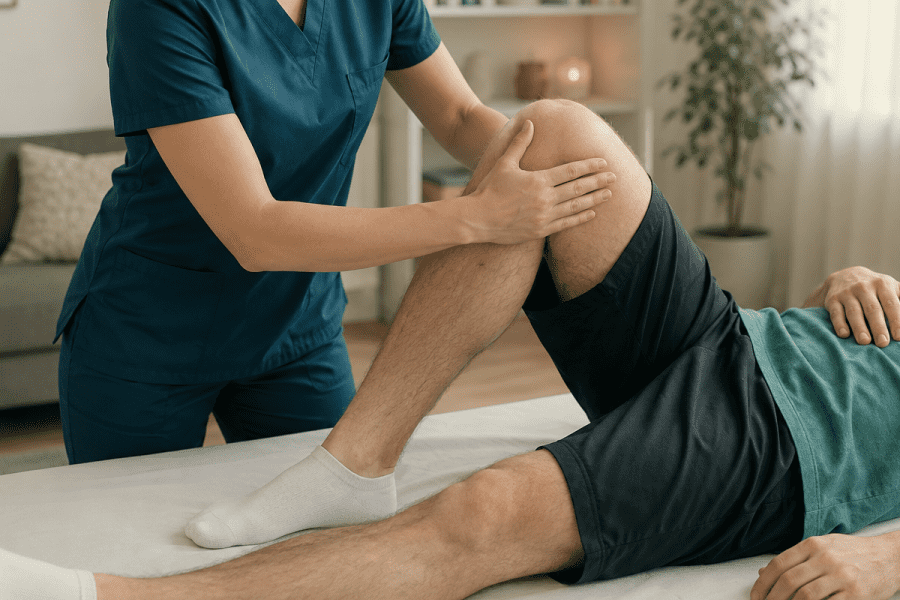
Treatment for almost all knee pain is built on a foundation of progressive strengthening, because strong muscles around the knee reduce the load on the joint surfaces and control the movement that causes pain. Alongside this, treatment includes hands-on techniques to improve movement and reduce stiffness, specific work for the kneecap mechanism where relevant, swelling management, and graded return to walking, stairs, and the activities that matter to you. Every session ends with a written exercise programme built around your home, using your own stairs and furniture as the equipment.
Knee pain treatment is part of our full musculoskeletal physiotherapy service in Derby, which covers the complete range of muscle, joint, and nerve conditions we treat at home.
Same-day appointments available. No GP referral needed.
Your visit is structured in three clear stages, with the time spent in each shaped by your condition and needs.
Your physiotherapist examines your knee's movement, stability, swelling, and strength, and watches you walk, climb your stairs, and rise from a chair to see the joint under real load. A history of how the pain started and what worsens it, combined with these functional tests, identifies what is driving the problem. Being at home means your actual stairs and seating are part of the assessment.
Treatment begins in the same visit with hands-on techniques to improve movement and ease pain, and the first stage of a strengthening programme targeting the muscles that support and control the knee. Each exercise is explained and matched to a level you can manage, so you can perform it correctly between visits.
You finish with a clear explanation of what is causing your knee pain, a progressive strengthening programme built around your home, guidance on managing stairs, walking, and activity, and an honest recommendation of how many sessions your recovery is likely to need, reviewed as you progress rather than fixed in advance.
Recovery depends heavily on the cause, so an accurate assessment is what makes a realistic timeline possible. As honest guidance, patellofemoral and muscle-related knee pain often improves substantially within six to twelve weeks of consistent strengthening. Knee osteoarthritis is a long-term condition rather than something that fully resolves, but a strengthening programme reliably reduces pain and improves function, and the benefits build over around three months and are maintained by continuing the exercises. Recovery from ligament injuries or knee surgery follows longer, structured timelines specific to the injury or procedure.
For knee osteoarthritis in particular, the evidence is clear and encouraging: strengthening the muscles around the knee is one of the most effective treatments available, and it works at any age.
Clear, direct answers about knee pain treatment, recovery, and booking.
Yes, and it is one of the most effective treatments available. Strengthening the muscles around the knee reduces the load on the worn joint surfaces, which reduces pain and improves function, and the evidence for this is strong at any age. Physiotherapy is recommended as a first-line treatment for knee osteoarthritis in UK clinical guidelines, often delaying or avoiding the need for surgery.
For most knee pain, appropriate exercise is far better than rest. Resting a painful knee allows the supporting muscles to weaken, which increases the load on the joint and tends to make the problem worse over time. The key is the right exercise at the right level, which is what an assessment establishes, rather than either complete rest or pushing through pain.
Usually not. Most knee pain can be accurately assessed and treated based on a clinical examination and your history, without a scan. Scans are helpful in specific situations, such as a suspected significant ligament or cartilage tear, and if your assessment suggests one is needed, we will coordinate that referral. For the majority of knee pain, treatment can begin straight away.
Yes. Every physiotherapist practising in the UK must be registered with the Health and Care Professions Council (HCPC), the statutory regulator for the profession, and our physiotherapists are Chartered Society of Physiotherapy members practising to its professional and ethical standards.
Home Physio Derbyshire delivers expert knee pain physiotherapy directly to your home. Same-day appointments available with no waiting lists.