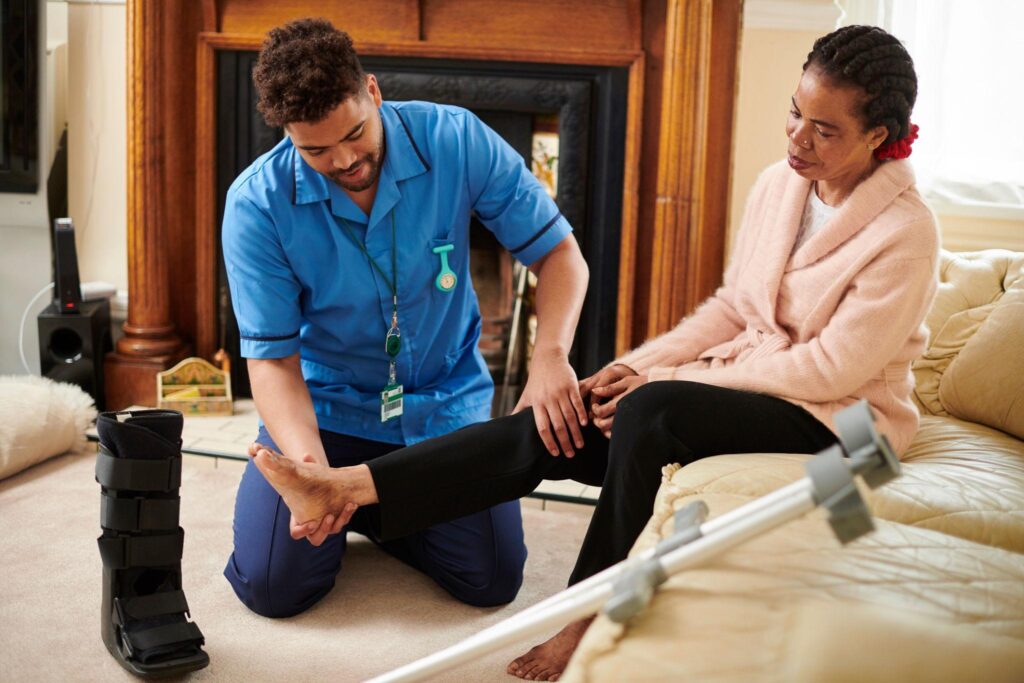
Most people ditch the stick around six weeks, reclaim something like normal life by three months, and keep gaining ground a year on.
That’s the short version, and it skips rather a lot. The first fortnight hits harder than almost anyone warns you. The middle stretch does the real work, and it’s also the bit where nothing appears to happen. The last of it creeps in so gradually you only spot it looking back.
One thing first. Your surgeon’s instructions win, always. Protocols vary between surgeons and between procedures, so where anything here clashes with what you were told at discharge, follow your surgical team. They’ve seen your knee. I haven’t.
Stage | What’s happening | What most people manage |
|---|---|---|
Days 0 to 7 | Pain and swelling peak | Short walks indoors with a frame, exercises several times a day |
Weeks 1 to 2 | Swelling lingers, sleep fractures | Navigating the house, stairs one at a time |
Weeks 2 to 6 | Pain eases, bend improves | Venturing outside, crutches down to one stick |
Weeks 6 to 12 | Many walk unaided | Most daily tasks, often back to desk work |
3 to 6 months | Strength and confidence rebuild | Normal routine, longer walks, most hobbies |
6 to 12 months | Gains slow but keep coming | Full return for the majority |
Read every one of those as a range rather than a schedule.
I’d underline that twice if I could. What usually happens is people spot the fastest number on the page, measure themselves against it, and conclude they’re falling behind. Your age, your general health, how stiff the knee had grown beforehand and how long you’d soldiered on with it all shift the picture, sometimes by weeks. None of that signals anything has gone wrong.
Nobody really braces you for that first week, so let’s be straight about it.
Pain peaks at night. Sleep shatters for a week or two, which drags everything else down with it. Swelling balloons in a way that looks genuinely alarming and almost always isn’t. The leg feels heavy and oddly borrowed, as though it belongs to somebody else entirely.
Plenty of people sink a bit emotionally in that first week too. That’s common, the anaesthetic and the broken sleep account for much of it, and it lifts.
What helps sounds duller than you’d hope. Ice and elevation. Taking your pain relief before the exercises rather than afterwards, so you can actually move through them. And chipping away at those exercises little and often across the day instead of facing one long session you’ve dreaded since breakfast.
Here’s what I’d most want you to know going in. Most people hit a moment in that first fortnight where they genuinely wonder whether they’ve made a terrible mistake. Nearly everyone has it. Nearly everyone leaves it behind.
These are the questions people actually ask, and they’re oddly hard to track down anywhere.
Showering. Hinges entirely on your wound and the dressing you came home with, so follow your surgical team on timing. Sort the practical side beforehand though: a shower seat, a non-slip mat and a long-handled sponge separate manageable from thoroughly miserable.
Sleeping on your side. You’ll start on your back. Side sleeping grows comfortable again for most people within the first month or two, with a pillow wedged between the knees. Avoid one thing throughout: never prop the knee on a pillow underneath the joint. It feels wonderful. It also coaxes the knee into settling at a bend, and clawing back full straightening once you’ve lost it takes real work.
Driving. Commonly around six weeks, though it isn’t really a date. The test is whether you could stamp on the brake in an emergency without flinching. Get clearance from your surgeon first, and ring your insurer too, because driving before you’re cleared can wipe out your cover. That second part catches people out.
Walking aids. Frame, then two crutches, then one, then a stick, then nothing. How fast you climb that ladder depends on how steady you feel rather than what the calendar says. Abandoning them too early breeds a limp you then have to unlearn, which drags on far longer than simply keeping the stick another fortnight would have.
Stairs. One step at a time at first. Good leg leads going up, operated leg leads coming down. Alternating feet usually returns in the second month, and it counts as a proper milestone. Mark it when it arrives.
Returning to work. Desk job with a short commute, often six to eight weeks. On your feet all day, considerably longer. Heavy manual work, longer again. If you can work from home part time somewhere in the middle, most people find that smoother than picking one hard return date and hoping.
This is the part I’d take most seriously.
The movement you win back early is largely the movement you keep. Scar tissue inside the knee matures across those first few months, and a knee that hasn’t recovered its bend by roughly the twelve week mark fights you much harder afterwards.
Straightening counts every bit as much as bending, incidentally, and it attracts a fraction of the attention. A knee that won’t fully straighten reshapes how you walk, and that surfaces later as an aching hip or back.
None of which means one missed week wrecks anything. It means the exercises in weeks two to eight, long after the novelty has worn off and while progress hides itself completely, carry most of the load. That stretch decides your recovery, and it’s also the stretch where nobody’s watching you.
Some things don’t deserve a few days to settle.
Ring your surgical team or GP straight away if calf pain, swelling, warmth or redness appears, particularly lower down the leg. Same if the wound reddens, heats up, starts discharging, or you run a temperature. If movement suddenly vanishes, or you can’t put weight through the leg when you managed it yesterday, that warrants a call too.
Pain that climbs rather than fades after the first couple of weeks deserves raising as well, rather than quietly enduring it.
Answers to common questions about recovery after knee replacement surgery.
Most people walk unaided around six weeks, reclaim ordinary daily life by roughly three months, and keep improving for up to a year. Those are typical ranges, and individual recovery varies a fair bit.
Commonly around six weeks, though it depends on whether you can perform an emergency stop safely and comfortably. Secure clearance from your surgeon and check where you stand with your insurer before you start.
Usually within the first month or two, with a pillow between your knees. Avoid propping the knee on a pillow underneath the joint at any stage, as that coaxes it into stiffening at a bend.
Most people swap a frame for crutches within the first fortnight, drop to a single stick around four to six weeks, and shed aids entirely around six. Steadiness drives it rather than dates.
Usually, yes. Swelling that ebbs and flows, and worsens after a busier day, belongs to the first few months. Swelling that climbs, or arrives with heat and redness, needs checking.
Rehabilitation usually begins in hospital and carries straight on at home. The weeks right after discharge count most, which is why arranging it before the operation beats scrambling afterwards.
Recovering from knee replacement surgery? Speak to our physiotherapist if you need support with your recovery.
Call +44 7368 156076Knee replacement recovery stretches longer than the headline numbers suggest, bites harder in that first fortnight than most people expect, and gets settled somewhere in the middle, while progress hides and nobody’s watching.
If you take one thing from all this, take this: the exercises between weeks two and twelve outweigh anything you’ll do later. They’re also the ones you’ll least fancy doing. That isn’t a coincidence.
And if you’ve got surgery booked, line up your rehabilitation before the operation rather than scrambling to arrange it in that first difficult week. Home Physio Derbyshire brings physiotherapy to you, which counts for more here than almost anywhere else, because this is precisely the stretch when you can’t drive and hauling yourself to a clinic is the last thing you want.
We cover a thirty mile radius of Derby, including Belper, Ripley, Alfreton, Matlock, Chesterfield, Ilkeston and Mansfield, along with the surrounding areas of Derbyshire and Nottinghamshire. No referral needed to book.
Book an assessment or get in touch if you’d rather talk it through first.