Private physiotherapy in the UK usually costs somewhere between £40 and £90 for a clinic session, and between £60 and £140 for a home visit, depending on where you live and who you see. A full course of treatment, which is what most people actually end up paying for, tends to land between £200 and £900.
That is a wide spread, and it is wide for a reason. Nobody pays for one session in isolation, and almost nobody knows how many sessions they need when they start ringing round. So this article covers both numbers: what a single session costs, and what the whole thing is likely to cost you by the time you are discharged.
Home visits are priced differently again, and we have given that its own section further down, including the parts of the cost that are easy to miss.
The table below shows the ranges commonly advertised by private providers across the UK in 2026.
Please read these as indicative market ranges rather than quotes. They are drawn from what providers typically advertise, and they vary considerably by region, by clinician, and by session length. They are not our prices, and they are not a price any individual provider is committed to. Always confirm the figure directly with whoever you are booking.
Type of appointment | Typical advertised range |
|---|---|
Initial assessment, clinic | £45 to £90 |
Follow-up session, clinic | £40 to £75 |
Initial assessment, home visit | £70 to £140 |
Follow-up session, home visit | £60 to £120 |
Specialist neurological or post-surgical home visit | £80 to £150 |
Two patterns are worth knowing before you start comparing.
The first is that your initial assessment nearly always costs more than the sessions that follow it. That first appointment is longer, it includes a full examination and diagnosis, and it usually produces a written treatment plan. Plenty of people are caught out by this when the second invoice arrives lower than the first, or worse, when the first arrives higher than the price they were quoted over the phone.
The second is regional variation, and it is significant. London and the South East sit at the upper end of every range above. The Midlands and the North generally sit in the middle. If a national average has told you to expect £50 and your local quote is £75, the average is not wrong and neither is the quote.
Session length matters too, and it is the easiest thing to get confused about. A £45 session sounds cheaper than a £70 one until you find out the first is thirty minutes and the second is a full hour. Compare the price per hour, not the price per appointment.
This is the number that matters, and it is the one almost nobody publishes.
Physiotherapy is not a single purchase. It is a course of treatment, usually spread over several weeks, with a home exercise programme running between visits. Working out whether you can afford it means knowing the total, not the per-session figure.
Here is roughly what different conditions tend to require. The session counts come from ordinary clinical practice. The totals are simply those session counts multiplied by the ranges in the table above, so treat them the same way: indicative, not quoted.
Condition | Typical number of sessions | Rough total, clinic | Rough total, home visits |
|---|---|---|---|
Straightforward back pain | 3 to 6 | £160 to £460 | £250 to £740 |
Sciatica or disc-related pain | 6 to 10 | £280 to £760 | £430 to £1,220 |
Post-surgical rehabilitation, knee or hip | 8 to 12 | £370 to £910 | £550 to £1,460 |
Neurological or ongoing mobility work | Ongoing, reviewed periodically | Varies | Varies |
A few things follow from this that are worth saying plainly.
Long-standing problems cost more than recent ones. Pain you have had for two years will take longer to resolve than pain you have had for two weeks, and that difference shows up on the invoice. Booking early is not just clinically better, it is usually cheaper.
Ongoing conditions do not work on a course model at all. Parkinson’s, multiple sclerosis, post-stroke recovery and long-term falls prevention are managed rather than fixed, often with periodic reviews rather than a block of consecutive sessions. If a provider quotes you a fixed course total for one of these, ask what happens when the course ends.
And be a little wary of any provider who tells you exactly how many sessions you will need before they have assessed you. They cannot know that. A good physiotherapist gives you an honest estimate after the first appointment and then revises it as you progress. That is not a provider hedging. It is a provider being straight with you.
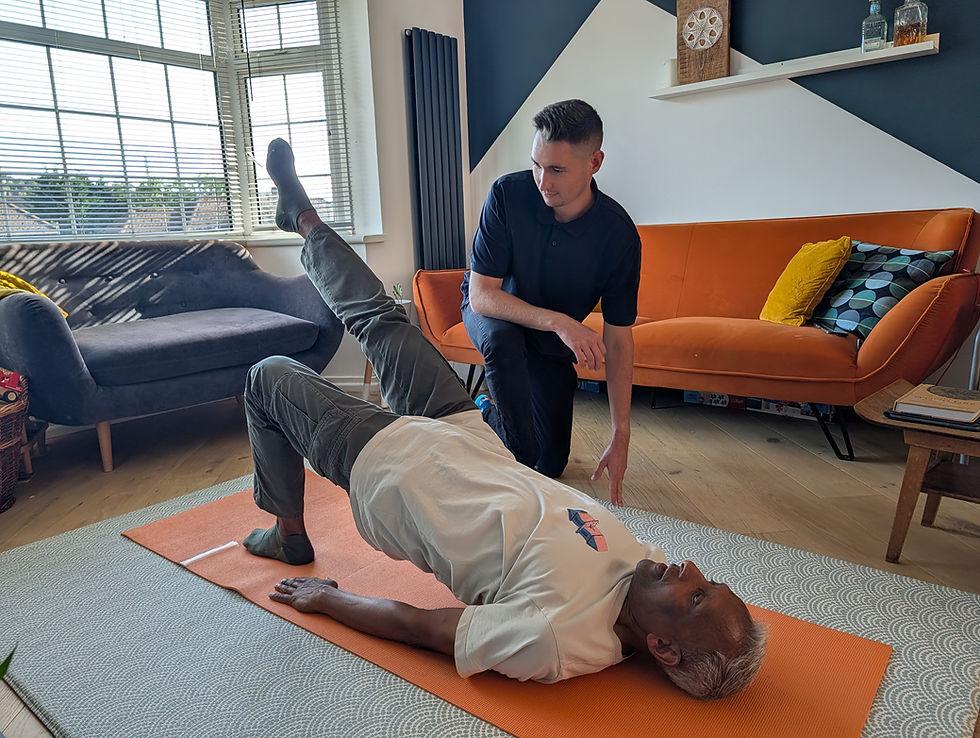
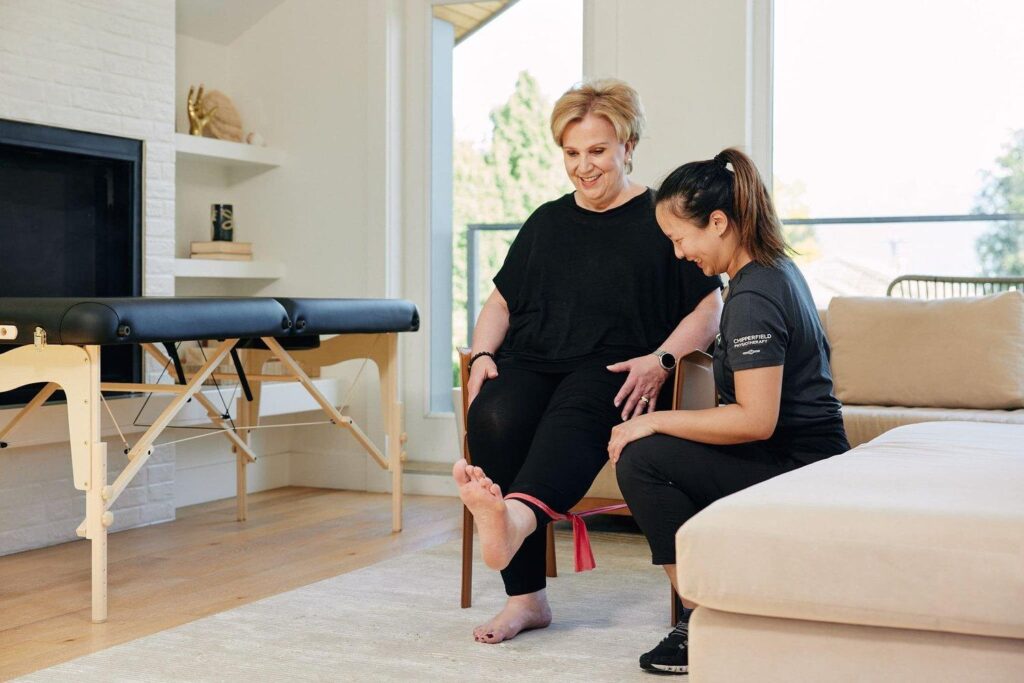
Home visits sit at the higher end of every range in this article, and it is worth being clear about why rather than glossing over it.
The price covers three things a clinic appointment does not:
That is the honest explanation for the difference. Anyone telling you home visits cost the same as clinic sessions is either running a loss or cutting something.
What is less obvious is the cost sitting on the other side of the comparison, which most people leave out entirely when they run the numbers.
Getting to a clinic is not free. There is fuel or a fare, there is parking, and for a course of eight sessions those add up to a real figure. There is time off work, which for anyone paid hourly is a direct cost. And there is the practical question of whether the journey itself aggravates the problem you are paying to fix, which anyone who has driven forty minutes with acute back pain will recognise.
For a good number of people, the comparison is not between two prices at all. If you have just had a hip replacement, or you are unsteady on your feet and no longer driving, or you are recovering from a stroke, a clinic appointment is not a cheaper option. It is not an available one.
There is a clinical argument for home treatment as well, and it is straightforward. Assessing someone in their own home shows the physiotherapist things a clinic cannot: the chair they sit in for six hours a day, the mattress behind the morning stiffness, the actual stairs they have to manage. Exercise programmes built around a patient’s own furniture and space tend to be easier to stick to than programmes built around gym equipment they do not own. Whether that shortens your particular course of treatment depends entirely on your condition, and we are not going to put a number on it.
The main factors, in rough order of how much difference they make:
Before you book anywhere, it is worth checking what you are actually getting for the fee. Ask whether the price covers:
And it is worth asking about the things that are sometimes charged separately:
None of these are unreasonable in themselves. They are only a problem when you find out about them after you have committed.
For transparency, here is exactly what we charge. These are our published prices, the same figures shown on our musculoskeletal physiotherapy page.
Appointment | Length | Price |
|---|---|---|
Initial assessment and treatment | 60 minutes | £130 |
Follow-up treatment session | 60 minutes | £115 |
Every appointment is a full hour, one to one, in your own home. The initial assessment includes a full biomechanical examination, clinical diagnosis, hands-on treatment within the same visit, a written home exercise programme, and red flag screening. Follow-up sessions include a progress review, an updated exercise programme, and hands-on treatment.
Home visit travel costs are included within our service area. Clinical notes are provided to your GP on request. Same-week appointments are usually available, and no GP referral is needed to book.

For most musculoskeletal problems that have stopped improving on their own, yes. Physiotherapy is the first-line recommended treatment for most back and joint pain in UK clinical guidelines, ahead of medication and imaging, and paying for it privately means starting within days rather than waiting.
But it is not the right answer for everyone, and it is worth saying so.
If your pain started in the last few days and is already easing, you may not need to pay for anything. A lot of acute strains settle with sensible activity and a bit of time. Waiting a week or two before booking is often the sensible choice.
If your symptoms include unexplained weight loss, night pain that stops you sleeping, numbness around the groin or saddle area, changes in bladder or bowel control, or progressive weakness in both legs, you need urgent medical attention rather than physiotherapy. Do not book an appointment with us or anyone else. Contact your GP or go to hospital.
And if what you actually need is a home assessment for grab rails, ramps or equipment, an occupational therapist is the right professional, not a physiotherapist. Sometimes both, but the order matters.
Any physiotherapist worth their fee will tell you if you are in one of these situations. Our physiotherapists are registered with the Health and Care Professions Council and members of the Chartered Society of Physiotherapy, and part of a proper first assessment is screening for exactly this. If your problem is not a physiotherapy problem, you should be told that at the first appointment, not the fifth.
Most UK private medical insurance policies include physiotherapy cover, though the detail varies a great deal between policies. Two things catch people out.
The first is that many insurers require a GP referral before they will authorise treatment, even when the physiotherapist does not. Physiotherapists are first-contact clinicians, so you can self-refer and book directly. Your insurer may still want the referral letter for their own purposes. Check before your first appointment rather than after.
The second is session limits. Policies frequently cap the number of sessions per condition or per year, and if your course runs longer you will be self-funding the remainder.
If you are planning to claim, ring your insurer first, confirm what they need and what they cover, and ask any provider you are considering whether they invoice insurers directly or whether you pay and claim back.
Quick answers on physiotherapy costs, session numbers and booking in the UK.
Typically £40 to £90 for a clinic session and £60 to £140 for a home visit, varying by region and clinician. Initial assessments usually cost more than follow-ups. Always check session length when comparing, as a thirty minute and a sixty minute appointment are not the same product.
Most straightforward back and joint problems need three to six sessions. Sciatica and disc-related pain often need six to ten. Post-surgical rehabilitation typically runs eight to twelve over a few months. You should get an honest estimate after your first assessment, reviewed as you go rather than fixed in advance.
Sometimes. A home visit costs more per session, but a clinic course carries fuel, parking and time off work across every appointment. For anyone who cannot drive or travel comfortably, the comparison does not really apply.
No. Physiotherapists are qualified first-contact clinicians, so you can book directly without a referral letter. Your insurer may require one even though your physiotherapist does not, so check with them if you are claiming.
Commonly £60 to £140 per session across the UK. Our own home visits are £130 for the initial assessment and £115 for follow-up sessions, both sixty minutes, with travel included within our service area.
Most private providers, including us, charge per session. You are not committing to a block. That said, physiotherapy works through a course of treatment, so budget for the whole thing rather than the first appointment.
Still have a question? Speak to our physiotherapist directly.
Call +44 7368 156076The honest answer to what private physiotherapy costs is that the per-session price tells you very little on its own. What matters is the total, and the total depends on your condition, how long you have had it, and how many sessions it genuinely needs. Anyone quoting you a firm total before they have examined you is guessing.
Our advice, whoever you end up booking with, is to ask three questions before you pay anything. How long is the session? What is included in the price. And what is your honest estimate of how many visits this will take. A provider who answers all three clearly is usually a provider worth booking.
If you are in Derby or Derbyshire, Home Physio Derbyshire brings private physiotherapy to your door. Our prices are published above and on our service pages, our sessions are a full hour, and travel is included within our service area. We cover a thirty mile radius of Derby, including Belper, Ripley, Alfreton, Matlock, Chesterfield, Ilkeston and Mansfield, along with the surrounding areas of Derbyshire and Nottinghamshire.
Same-week appointments are usually available and no GP referral is needed. If you are not sure whether we reach your postcode, call or send a WhatsApp message and we will confirm within a few hours.
Book your initial assessment, £130 or call +44 7368 156076 to talk it through first.