Home Physio Derbyshire provides private physiotherapy for spasticity after stroke in Derby and across Derbyshire, delivered directly to your home. When muscles have become tight, stiff, or difficult to control after a stroke, consistent management is what keeps movement and comfort, and our physiotherapists deliver it at home alongside your wider care team, with no GP referral needed.
Spasticity is a common effect of stroke where muscles become tight, stiff, and resistant to movement, because the stroke has disrupted the way the brain regulates muscle tone. It often develops in the weeks and months after a stroke rather than immediately, and can affect the arm, hand, leg, or foot. Left unmanaged, spasticity can make movement harder, cause discomfort, and lead to longer-term stiffness in the joints, which is why consistent management is important. With the right ongoing physiotherapy, spasticity can be managed to preserve movement, comfort, and function.
Spasticity after a stroke can cause:
Because spasticity tends to be an ongoing issue rather than a one-off problem, regular, consistent management is what keeps it under control and protects movement and comfort.
Managing spasticity is not a one-off treatment but an ongoing process, because tone can change over time and the muscles need regular movement and stretching to stay as supple as possible. Consistent physiotherapy helps maintain range of movement, reduce discomfort, and preserve function, and it also helps prevent the lasting joint stiffness that can develop when tight muscles are left unmoved. This regular input is exactly what home-based physiotherapy is well placed to provide.
Our physiotherapists work alongside your GP, stroke team, and wider care network, including where you are receiving medical treatments for spasticity, and our rehabilitation complements that care. Every assessment also includes structured screening, drawing on our physiotherapists' advanced clinical diagnostic training to monitor your condition and identify anything that needs to be flagged to your medical team, so your care stays safe and coordinated.
Contact your GP or medical team promptly, rather than waiting for your next physiotherapy visit, if spasticity suddenly worsens, becomes painful, or is accompanied by skin breakdown, or if a joint is becoming fixed and cannot be moved. A sudden change can sometimes signal another problem and may need medical review or a change in treatment.
Managing spasticity well depends on regular movement, stretching, and positioning woven into daily life, and that daily life happens at home. During home visits your physiotherapist works directly on the affected muscles and joints, and, just as importantly, sets up a practical daily routine of stretches, positioning, and movement that fits your home and can be maintained between visits. Seeing your actual seating, bed, and daily tasks allows genuinely practical positioning and handling advice for you and any carers.
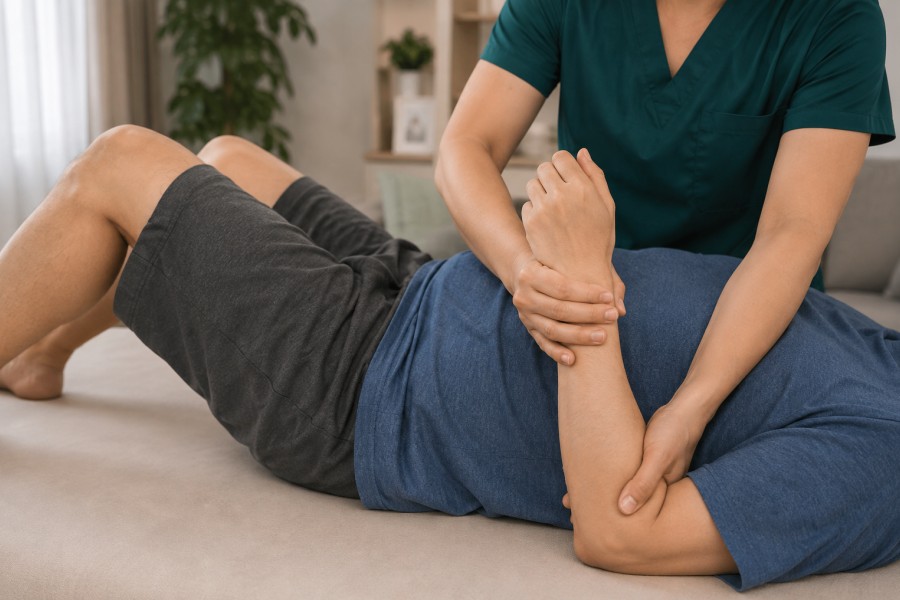
Physiotherapy for spasticity combines hands-on techniques and stretching to maintain range of movement, guided active movement of the affected limb, positioning and splinting advice where helpful, and functional practice to keep the limb as useful as possible. Where you are also receiving medical treatments such as botulinum toxin, physiotherapy works alongside them to make the most of the window they provide. Every session ends with a written home programme of stretches and movement, and guidance for family or carers on safe handling and positioning.
Spasticity management is part of our full stroke rehabilitation service in Derby, which supports recovery of movement, function, and independence after stroke at home.
Same-day appointments available. No GP referral needed.
Your visit is structured in three clear stages, with the time spent in each shaped by your condition and needs.
Your physiotherapist assesses muscle tone, range of movement, comfort, and how spasticity is affecting movement and daily tasks, and sets practical goals with you, whether that is easier hand care, better positioning, or maintaining movement. Being at home means the seating, bed, and daily tasks involved are part of the assessment.
Treatment is delivered in the same visit, combining hands-on stretching and techniques to reduce tightness with guided active movement and positioning work. Each stretch and technique is explained clearly, along with how and when to do it, so it can be carried out safely between visits by you or a carer.
You finish with a clear understanding of your spasticity and how to manage it, a written home programme of stretches, movement, and positioning, practical handling guidance for family or carers, and an honest view of the ongoing plan, reviewed and adjusted as your tone and needs change.
Honesty matters here: spasticity is often an ongoing feature after a stroke rather than something that fully disappears, but it can be managed effectively, and consistent physiotherapy makes a real difference to movement, comfort, and function. The goals are to maintain range of movement, reduce stiffness and discomfort, keep the affected limb as useful as possible, and prevent the lasting joint stiffness that can otherwise develop. With regular management, many people keep spasticity well controlled and protect their movement over the long term.
The most important factor is consistency, regular stretching, movement, and positioning maintained as part of daily life. Because tone can change over time, ongoing input and adjustment matter, which is why regular, home-based management is so valuable, and why involving family or carers in the daily routine strengthens the results.
Clear, direct answers for stroke survivors and families about spasticity, home rehabilitation, and booking.
Spasticity is muscle tightness and stiffness that develops after a stroke because the stroke has disrupted how the brain controls muscle tone. It often appears in the weeks or months after the stroke and can affect the arm, hand, leg, or foot, making muscles hard to move and sometimes uncomfortable. It is common and manageable, and consistent physiotherapy helps maintain movement and comfort.
Yes. Regular stretching, guided movement, and positioning help maintain range of movement, reduce stiffness and discomfort, and keep the affected limb as functional as possible. Physiotherapy also helps prevent the lasting joint stiffness that can develop when tight muscles are left unmoved. Because tone can change over time, ongoing management works better than a one-off course.
Yes, they work well together. Where your medical team provides treatments such as botulinum toxin to reduce tone, physiotherapy makes the most of the window that creates, using the reduced tightness to stretch, move, and retrain the limb more effectively. We coordinate with your medical team so the physiotherapy complements your medical treatment rather than duplicating it.
Yes. Every physiotherapist practising in the UK must be registered with the Health and Care Professions Council (HCPC), the statutory regulator for the profession, and our physiotherapists are Chartered Society of Physiotherapy members practising to its professional and ethical standards.
Home Physio Derbyshire delivers expert spasticity management after stroke directly to your home, for stroke survivors and the families supporting them. Same-day appointments available with no waiting lists.