Home Physio Derbyshire provides private Achilles tendinopathy treatment in Derby and across Derbyshire, delivered directly to your home. If the back of your heel or lower calf is painful and stiff, especially with the first steps in the morning or when you get active, our physiotherapists identify what is overloading the tendon and treat it around your daily routine, with no GP referral needed.
Achilles tendinopathy is a common overload problem affecting the Achilles tendon, the strong band at the back of the ankle that connects the calf muscles to the heel and drives every step, push-off, and jump. It develops when the tendon is loaded faster than it can recover, causing pain, stiffness, and sometimes thickening of the tendon, typically felt at the back of the heel or a little higher in the tendon. Like other tendon problems, it responds to a specific loading approach that rebuilds the tendon's capacity, rather than to rest alone.
The most common causes and contributors include:
Because the tendon is sensitive to how it is loaded, treatment focuses on managing that load and progressively rebuilding the tendon's tolerance, alongside addressing the calf strength and flexibility that so often drive it.
It is worth seeing a physiotherapist if Achilles pain has persisted beyond two to three weeks, keeps returning when you resume activity, or is limiting walking, work, or exercise. Getting the loading approach right early makes a real difference, because Achilles tendinopathy is well known for lingering for many months when managed with rest alone. You do not need to wait for a GP appointment or referral, our physiotherapists assess and treat Achilles problems directly as first-contact clinicians.
Achilles tendinopathy is usually a clear diagnosis, but one serious problem must be distinguished from it. Every assessment includes structured screening, drawing on our physiotherapists' advanced clinical diagnostic training to confirm the diagnosis and rule out an Achilles tendon tear or rupture, which presents differently and needs different management. If anything suggests more than a tendinopathy, we tell you honestly and coordinate the right referral.
Seek urgent medical assessment rather than starting physiotherapy if you felt a sudden snap or a sensation of being kicked in the back of the ankle, followed by difficulty walking or pushing off, or if you cannot rise onto your toes. These can indicate an Achilles tendon rupture, which needs prompt medical assessment rather than a rehabilitation programme.
Achilles tendinopathy is driven by the loads of daily life and activity, the walking, standing, stairs, and exercise that are part of your routine, so understanding and adjusting those loads is central to treating it. During a home visit your physiotherapist can review your real activity, footwear, and the stairs and surfaces you use, and set a loading programme that fits your day. Seeing your actual routine allows practical, specific advice on managing the loads that keep the tendon irritated, which a clinic can only ask about.
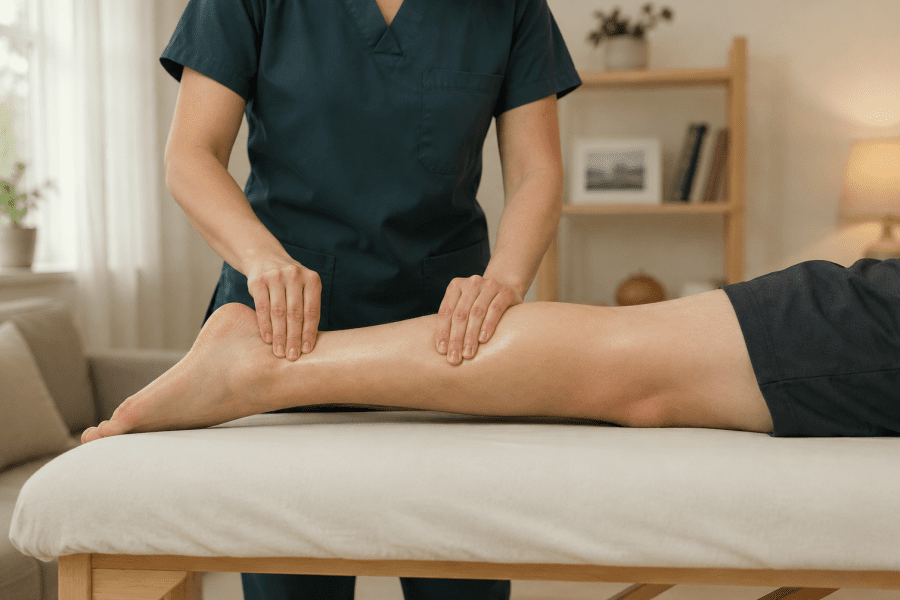
Treatment centres on a progressive loading programme for the calf and Achilles tendon, the approach with by far the strongest evidence for tendon problems, which gradually rebuilds the tendon's tolerance rather than resting it into further weakness. Alongside this, treatment includes calf strengthening and flexibility work, hands-on techniques to ease pain, footwear and load-management advice, and a graded return to walking, activity, and sport. Every session ends with a written exercise programme built around your daily demands, because consistent loading between visits is what drives recovery.
Achilles tendinopathy treatment is part of our full musculoskeletal physiotherapy service in Derby, which covers the complete range of muscle, joint, and nerve conditions we treat at home.
Same-day appointments available. No GP referral needed.
Your visit is structured in three clear stages, with the time spent in each shaped by your condition and needs.
Your physiotherapist confirms the diagnosis by testing the tendon and calf, checks your calf strength and flexibility, and takes a history of the activity, footwear, and loads driving the problem. Being at home means your real footwear, stairs, and daily activity can be reviewed directly, which matters for a condition so driven by load.
Treatment begins in the same visit with hands-on work to ease pain and the first stage of your calf and tendon loading programme, set to a level the tendon can tolerate. The principle is to load the tendon enough to stimulate recovery without flaring it, and each exercise is explained clearly so you can perform it correctly on your own.
You finish with a clear explanation of why the tendon became overloaded, a progressive loading programme, practical footwear and activity guidance, and an honest recommendation of how many sessions your recovery is likely to need, reviewed as you progress rather than fixed in advance.
Achilles tendinopathy tests patience, because tendons recover slowly and the timeline is longer than many people expect. As honest guidance, many cases improve substantially over three to six months of a consistent loading programme, though more stubborn or long-standing cases can take longer. The encouraging point is that progressive loading has strong evidence for genuine recovery rather than just short-term relief, provided the programme is followed consistently and the aggravating loads are managed alongside it.
The most common reason Achilles problems drag on is stop-start management, resting until the pain eases, returning to full activity, and overloading the tendon again, or expecting a quick fix. Steady, progressive loading with sensible activity management is what breaks that cycle, which is why the home programme and practical guidance matter as much as the hands-on treatment.
Clear, direct answers about Achilles tendinopathy treatment, recovery, and booking.
No, and this is a common mistake. Complete rest may ease the pain briefly, but it weakens the tendon and calf, so the problem returns as soon as you resume activity. The evidence-based approach is progressive loading, keeping the tendon working at a level it can tolerate while managing the specific activities that flare it. Your programme is set to that balance, so the tendon rebuilds its capacity rather than losing it.
Morning stiffness and pain in the Achilles is a classic feature of tendinopathy. The tendon stiffens overnight while you rest, so the first steps in the morning load it suddenly, which is stiff and painful, then it often eases as you warm up and move. This morning stiffness is a useful marker your physiotherapist uses to track progress, as it tends to reduce as the tendon recovers.
Often yes, but in a managed way rather than pushing through. Many people can continue some activity at a level the tendon tolerates, while following a loading programme and adjusting the aggravating loads, which is usually better than stopping completely. The right amount is individual, and your assessment sets a plan that lets you stay as active as possible without flaring the tendon, then progresses your return as it recovers.
Yes. Every physiotherapist practising in the UK must be registered with the Health and Care Professions Council (HCPC), the statutory regulator for the profession, and our physiotherapists are Chartered Society of Physiotherapy members practising to its professional and ethical standards.
Home Physio Derbyshire delivers expert Achilles tendinopathy treatment directly to your home. Same-day appointments available with no waiting lists.