Home Physio Derbyshire provides private physiotherapy for balance and gait after stroke in Derby and across Derbyshire, delivered directly to your home. When a stroke has affected your standing, balance, or walking, targeted rehabilitation is what restores safe, confident movement, and our physiotherapists deliver it on the floors and stairs you use every day, working alongside your wider care team, with no GP referral needed.
A stroke often affects balance and walking, because standing steady and walking safely rely on strength, coordination, sensation, and the brain's control of movement, any of which a stroke can disrupt. Many stroke survivors develop an altered walking pattern as they compensate for weakness on one side, which can make walking effortful, uneven, and less safe. The encouraging basis for recovery is neuroplasticity, the brain's ability to relearn control through repeated, specific practice, which means balance and walking can genuinely improve with focused, task-specific rehabilitation.
After a stroke, balance and gait problems commonly include:
Because safe walking underpins so much of daily independence, restoring balance and gait is one of the most valuable goals in stroke rehabilitation.
Regaining safe balance and walking is central to independence after a stroke, and it is also key to safety, because stroke survivors have a notably higher risk of falls. Focused rehabilitation improves not only the mechanics of walking but the confidence to move, and the two reinforce each other. Continued, specific practice matters, because balance and gait keep improving with the right input well beyond the early weeks, and structured rehabilitation is what turns that potential into safer, steadier movement.
Our physiotherapists work alongside your GP, stroke team, and wider care network. Every assessment also includes structured screening, drawing on our physiotherapists' advanced clinical diagnostic training to monitor your recovery and identify anything that needs to be flagged to your medical team, so your rehabilitation stays safe and well-coordinated.
If you or someone else shows sudden signs of a new stroke, remember FAST: Face drooping, Arm weakness, Speech difficulty, Time to call 999. Any sudden new weakness, numbness, difficulty speaking, or loss of balance needs emergency medical attention immediately, not a physiotherapy appointment.
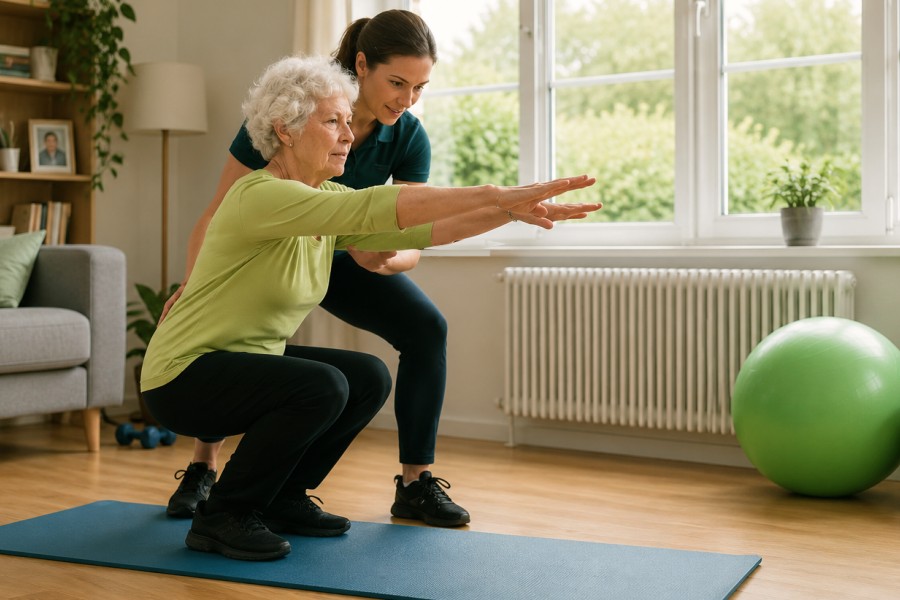
Balance and walking are used in your own home, on your own floors, around your own furniture, on your own stairs, and this is exactly where they are best retrained. During home visits your physiotherapist works on standing balance, weight-bearing through the affected side, and walking in the real spaces and on the real surfaces you navigate daily, which makes every gain immediately practical. Practising in the actual environment where you move gives the brain the most meaningful, repeatable practice, and it directly rebuilds the confidence that safe walking depends on.
Rehabilitation combines task-specific balance and gait retraining with progressive strengthening of the affected side, weight-bearing and stepping practice, work on turning and stairs, and hands-on techniques to support movement. It is delivered in coordination with your wider care team and progressed as you recover, always at a pace that builds safety and confidence. Every session ends with a written home programme, because the repetition between visits maintains the momentum, and family or carers can support it safely where helpful.
Balance and gait rehabilitation is part of our full stroke rehabilitation service in Derby, which supports recovery of movement, function, and independence after stroke at home.
Same-day appointments available. No GP referral needed.
Your visit is structured in three clear stages, with the time spent in each shaped by your condition and needs.
Your physiotherapist assesses your standing balance, weight-bearing, walking pattern, and how you manage turning, stairs, and daily movement, and sets meaningful goals with you, the specific things you want to move around safely to do. Being at home means these are grounded in your real surfaces, spaces, and routine.
Treatment is delivered in the same visit, combining hands-on techniques with task-specific balance and gait practice and strengthening, worked through real standing, stepping, and walking. Each activity is set to a safe, appropriate level and explained clearly, so it can be repeated correctly between visits.
You finish with a clear picture of your progress, a written home programme of balance and walking exercises to repeat between sessions, guidance for you and any family or carers, and an honest view of the path ahead, reviewed and progressed as your steadiness and confidence grow.
Recovery of balance and walking after a stroke is individual, and honesty about that matters. Improvements often come steadily with consistent, focused rehabilitation, and, importantly, balance and gait can keep improving well beyond the early weeks and months, as the brain continues to relearn control with repeated practice. How much and how quickly someone recovers depends on the stroke and varies widely, which is why we focus on your individual goals and steady, measurable progress rather than a fixed prediction.
What is consistent is that specific, repeated practice of balance and walking, in the environment where they are used, drives recovery, and that building confidence is as important as building the physical ability. Continuing to practise safely, with the right guidance, is the single most important factor in regaining steady, confident movement.
Clear, direct answers for stroke survivors and families about walking, balance, home rehabilitation, and booking.
Yes. Balance and walking can keep improving well beyond the early weeks and months after a stroke, because the brain retains its ability to relearn movement through repeated, specific practice. Focused gait and balance rehabilitation regularly produces meaningful gains in steadiness and walking later in recovery, so it is rarely too late to work on safer, more confident movement.
An altered walking pattern is very common after a stroke, as the body compensates for weakness, changed sensation, or reduced control on one side. This can make walking uneven and effortful. Physiotherapy works to retrain a safer, more efficient pattern by strengthening the affected side and practising walking in a structured way, which is most effective when done in your real environment on the surfaces you use daily.
Yes, this is a core aim. Stroke survivors have a higher risk of falls, and improving balance, strength, and a safe walking pattern directly reduces that risk, while also rebuilding the confidence to move. Practising in your own home, on your own stairs and floors, is especially effective, because it makes the improvements immediately relevant to where falls are most likely to happen.
Yes. Every physiotherapist practising in the UK must be registered with the Health and Care Professions Council (HCPC), the statutory regulator for the profession, and our physiotherapists are Chartered Society of Physiotherapy members practising to its professional and ethical standards.
Home Physio Derbyshire delivers expert balance and gait rehabilitation after stroke directly to your home, for stroke survivors and the families supporting them. Same-day appointments available with no waiting lists.