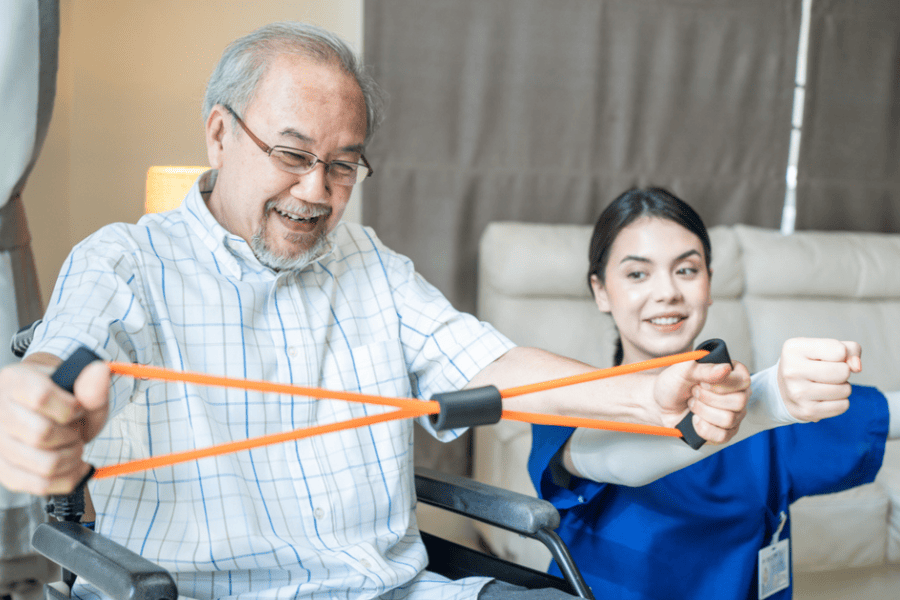
Home Physio Derbyshire provides specialist elderly mobility physiotherapy in Derby and across Derbyshire, delivered directly to your home. Whether you are concerned about a parent losing confidence with walking, recovering after a fall, or managing a long-term condition affecting balance, our physiotherapists deliver clinical falls prevention and personalised mobility programmes without the need for travel.
Falls are the leading cause of injury-related hospital admissions among adults over 65 in the UK, with more than one third of older adults experiencing at least one fall per year. The consequences extend beyond physical injury, fear of falling frequently leads to reduced activity, social withdrawal, and accelerating physical deconditioning that further increases fall risk. Early, targeted physiotherapy within the home is one of the most clinically effective ways of breaking this cycle.
A clinic-based falls assessment evaluates balance and strength in a controlled environment that bears no resemblance to where falls happen. A home visit allows a comprehensive falls risk assessment and home hazard evaluation in the exact environment where your relative lives and moves daily, identifying specific risks on their actual staircase, in their bathroom, across their flooring, and during the daily tasks that genuinely challenge their balance.
Every assessment goes beyond standard balance exercises to include clinical gait analysis, postural stability testing, walking aid assessment, and structured strength and balance programmes tailored to the patient's home and routine. Consultations are available in English, Urdu, Punjabi, and Hindi, so elderly patients and their families can communicate comfortably throughout every stage of rehabilitation.
Home Physio Derbyshire provides targeted physiotherapy and falls prevention programmes across the four areas that most affect independence in later life.
Falls prevention begins with a thorough clinical assessment of the factors contributing to fall risk, muscle weakness, balance deficits, medication effects, vision changes, and home hazards.
A structured programme then addresses each identified risk through targeted strength and balance training, practical home modifications, and safe movement education, reviewed and progressed at every visit.
Reduced balance and lower limb strength are the two most changeable fall risk factors in older adults, and targeted rehabilitation produces clinically meaningful improvements in stability and confidence.
Treatment combines progressive balance training, strengthening exercises, and functional movement practice matched to current ability, building the physical foundations that independent daily living depends on.
Parkinson's disease progressively affects movement, balance, and walking pattern, and physiotherapy is one of the most evidence-based interventions for maintaining independence as the condition develops.
Home treatment focuses on gait retraining, freezing management, cueing strategies, and progressive strengthening, updated regularly as needs change and always practised in the environment where daily mobility actually happens.
After a fall, fear of falling often drives reduced activity and further deconditioning, a cycle that quietly increases the risk of the next fall while independence shrinks.
Rehabilitation combines strength and balance retraining, safe movement education, and gradual reintroduction of daily activities, rebuilding physical capability and confidence together, with family involvement encouraged throughout.
Every visit is structured around assessment, treatment, and family guidance, with the time spent in each stage shaped by your relative's needs on the day.
Your physiotherapist assesses balance responses, lower limb strength, walking pattern, medication history, and vision, with initial visits including a home hazard evaluation alongside the clinical assessment, identifying environmental risks on the staircase, in the bathroom, and along daily movement routes.
Targeted treatment combines progressive balance training, strengthening exercises, gait retraining, and functional practice, performed in the patient's actual environment using their own furniture, flooring, and movement routes, so every exercise reflects the real daily demands their independence depends on.
The session closes with a clear written exercise programme and practical guidance for family or carers, covering safe assisted walking techniques, transfer assistance, and home modification recommendations, so those providing daily support can help maintain progress between visits.
By the end of every visit, you will have a clear picture of current fall risk, targeted treatment completed, and a practical plan that keeps both mobility and confidence building between sessions.
Same-day appointments available. No GP referral needed.
Home Physio Derbyshire provides transparent, fixed-fee physiotherapy with no hidden charges and no waiting lists. Every visit includes family and carer guidance as standard.
Physiotherapy reduces fall risk by addressing the specific factors behind instability, muscle weakness, balance deficits, gait changes, and home hazards. A structured programme of progressive balance and strength training, combined with home hazard evaluation, consistently reduces fall frequency and severity, and home assessment is particularly effective because risks are identified where falls happen.
Evidence-based balance exercises include single leg standing, tandem walking, sit-to-stand repetitions, and progressive stepping practice, all individually prescribed based on current ability and fall risk. A home assessment makes sure every exercise is safe and practical within the patient's own space and routine.
Yes. Walking aid assessment is a core part of every mobility visit. The right aid depends on the specific balance deficit, strength level, home layout, and outdoor needs, and the wrong aid can increase rather than reduce fall risk. Home assessment allows the aid to be fitted and practised in the environment where it will actually be used.
Arrange a physiotherapy assessment as soon as possible to identify the cause, check for injury, and begin structured rehabilitation. An assessment can usually be arranged within the same week, which matters because fear of falling develops quickly and becomes harder to reverse the longer activity stays reduced.
Yes. Our physiotherapists are Chartered Physiotherapists registered with the Health and Care Professions Council (HCPC), DBS checked, and fully insured for treatment with older adults in home settings.
Home Physio Derbyshire delivers specialist mobility and falls prevention physiotherapy directly to your relative's home, with family guidance included in every session.