Home Physio Derbyshire provides private stroke rehabilitation in Derby and across Derbyshire, delivered directly to your home. Structured, evidence-based recovery programmes help stroke survivors regain movement, independence, and confidence, with families and carers involved at every stage of the rehabilitation journey.
Stroke recovery depends on neuroplasticity, the brain's ability to form new neural connections through repetitive, task-specific practice. Clinical evidence is clear that recovery is strongest when rehabilitation is early, intensive, and frequent, and when practice happens in the environment where daily life takes place. For most stroke survivors, that environment is home, not a clinic treatment room.
Community physiotherapy following hospital discharge is often limited in frequency and duration, ending long before recovery potential is exhausted. Many stroke survivors are discharged with significant remaining potential for improvement, months and even years after their stroke. Private home rehabilitation fills that gap, providing consistent, structured input for as long as it continues to produce meaningful progress.
Our physiotherapists build every programme around the daily activities that matter most to you, walking to your own bathroom, managing your own stairs, making a drink in your own kitchen. Task-specific training in the real environment produces improvement that transfers directly into daily independence, which is the outcome that matters most to survivors and families alike.
Every stroke is different. Home Physio Derbyshire builds individualised rehabilitation programmes across the four areas where stroke most commonly affects daily life.
Weakness on one side of the body, known clinically as hemiparesis, is the most common effect of stroke, limiting walking, transfers, and everyday tasks that depend on strength and coordination.
Treatment uses repetitive, task-specific movement training and progressive strengthening to rebuild motor control, with every exercise built around your own furniture, stairs, and the daily routines you want back.
Increased muscle tone after stroke can cause stiffness, pain, and positioning difficulties, affecting comfort, sleep, and the ability to perform daily tasks with the affected limbs.
Treatment combines targeted stretching programmes, positioning strategies, and movement retraining to manage tone, maintain joint range, and keep movement as comfortable and functional as possible.
Stroke frequently affects balance and walking pattern, increasing fall risk and reducing confidence, which often leads to reduced activity and further physical decline over time.
Gait retraining combines hands-on facilitation, balance rehabilitation, and progressive walking practice on your actual home surfaces, carpets, thresholds, and stairs included, so every improvement transfers directly to daily life.
Arm and hand recovery often lags behind walking recovery and needs dedicated, focused rehabilitation work. Without it, learned non-use of the affected arm becomes progressively harder to reverse.
Treatment uses repetitive task practice, graded functional activities, and carer-supported daily practice programmes to drive upper limb recovery at every stage, from early movement to fine hand function.
Every visit is structured around assessment, treatment, and family guidance, with the time spent in each stage shaped by your recovery stage and energy levels.
Your physiotherapist assesses movement, strength, balance, muscle tone, and current functional ability, then works with you and your family to set specific, meaningful goals for the daily tasks you most want back. Initial visits establish a full baseline that every following session builds on.
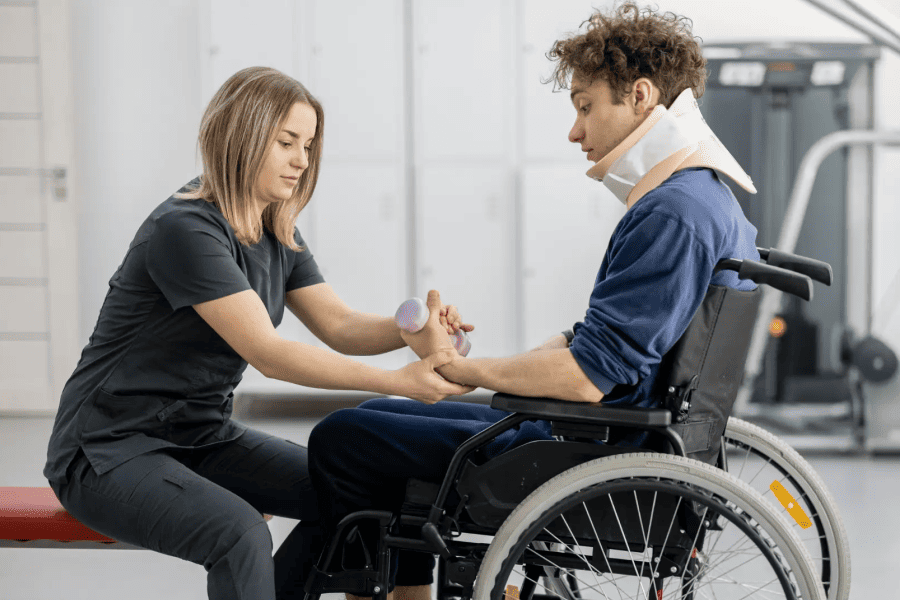
Treatment combines hands-on facilitation, guided movement practice, balance work, and task-specific training using your own home environment, with repetition and intensity matched to your current stage and fatigue levels, and every activity chosen for its direct carryover to daily independence.
Every session closes with a written practice programme and practical guidance for family members and carers, covering safe assistance techniques, positioning, and how to support daily practice without taking over the tasks the survivor is relearning for themselves.
By the end of every visit, you will have a clear picture of current progress, targeted treatment behind you, and a structured practice plan that keeps recovery moving until the next session.
Same-day appointments available. No GP referral needed.
Home Physio Derbyshire provides transparent, fixed-fee stroke rehabilitation with no hidden charges and no waiting lists. Every visit includes family and carer guidance as standard.
Home rehabilitation can begin as soon as you are discharged from hospital, and starting early matters. The first weeks and months are when the brain's recovery response is strongest. Same-day appointments mean structured private stroke rehabilitation can begin without a gap after discharge.
Yes. While recovery is fastest in the early months, clinical research consistently shows meaningful improvement remains possible years after a stroke with structured, intensive, task-specific rehabilitation. A recovery plateau often reflects reduced rehabilitation input rather than exhausted potential.
Frequency depends on your goals and recovery stage. In early recovery, two to three sessions weekly typically produce the strongest progress, supported by daily home practice. In later stages, weekly or fortnightly sessions with a strong self-practice programme maintain and build function. Your physiotherapist will make a recommendation based on your assessment.
Yes, wherever possible. Family and carer involvement consistently improves
Yes. Our physiotherapists are Chartered Physiotherapists registered with the Health and Care Professions Council (HCPC), the UK's statutory regulator, with clinical experience in neurological rehabilitation including stroke recovery at every stage.
Home Physio Derbyshire delivers structured stroke rehabilitation directly to your home, with families involved at every stage. Same-day appointments available.